.avif)



Physical Contamination in Food Manufacturing: Examples, Sources, and Controls


In June 2026, MorningStar Farms recalled two plant-based products over possible plastic pieces. In a BRCGS review of 2024 recalls across four countries, physical contamination was the underlying cause of 4 to 28% of recalls, and metal was the biggest physical cause in the USA at 36%.
Much of what you'll read about physical contamination is written by people who sell detectors. A detector is your last line of defense and the least informative one: it tells you metal reached the line, not where it came from. This guide covers the program around it: sources, FDA's size rule, prevention, incident response and records.
What is physical contamination?
Physical contamination is any foreign object or material in food that can injure a consumer or make the product unfit to eat, such as glass, metal, hard plastic, stone or wood picked up during harvest, processing, packing or storage.
It is one of the three food safety hazards regulators name, alongside biological and chemical. In your hazard analysis, the same thing is called a physical hazard.
Physical contamination, foreign material, foreign objects, extraneous matter: are they the same?
Mostly, yes, but the agencies draw lines that affect how you document a find.
- Foreign material and foreign objects are the everyday terms. FSIS Directive 7310.5 defines foreign materials as non-animal objects "such as metal, plastic, rubber, glass, wood, steel, or lead shot."
- Extraneous material is the regulatory phrase in FDA's CGMPs and FSIS's recall category. In 2024 it accounted for 4 of 34 FSIS recalls, covering 397,479 pounds.
- Natural defects are a separate category for FDA, which handles unavoidable ones through Defect Action Levels rather than as foreign objects.
Examples of physical contamination, by source (the 6 Ps)
The quickest way to find your exposures is to walk the plant by source. UK food hygiene training groups them as the 6 Ps: people, premises, plant, packaging, pests and products.
| Source | Typical contaminants | Typical entry point |
|---|---|---|
| People | Hair, fingernails, jewelry, bandages, pens, earplugs, glove fragments | Hand contact and pockets above open product |
| Premises | Flaking paint, ceiling tiles, light-fitting glass, insulation, cable sheathing | Overhead structures above exposed product |
| Plant | Nuts, bolts, wire, blade and screen fragments, gasket and belt wear, brush bristles | Equipment wear, breakdowns and engineering work |
| Packaging | Glass shards, cardboard, staples, strapping, film, pallet wood | Intake, unpacking, debagging and filling |
| Pests | Insects, droppings, rodent hair | Gaps in proofing, open doors, stored product |
| Products | Stones, bone, shell, pits, stalks, field debris | Raw materials from the farm, sea or supplier |
Pests are also a biological hazard, so your pest program has to cover both.
When a natural component counts as contamination
Bones in fish and shell in nuts are part of the food. FDA considers hard natural components unlikely to cause injury because consumers expect them, and it leaves many of them to the Defect Action Levels in its Food Defect Levels Handbook.
The exception is your label. If it says the hard component has been removed, its presence becomes unexpected, and FDA's own example is pit fragments in pitted olives. A "pitted" or "shelled" claim raises the bar your controls have to meet.
How dangerous is it? FDA's 7 to 25 mm rule, explained
Hard or sharp objects can cause traumatic injury. FDA lists laceration and perforation of the mouth, tongue, throat, stomach and intestine, plus damage to teeth and gums. A 2023 review in Food Science & Nutrition cites evidence that 1% to 5% of ingested foreign objects cause minor to serious injury.
FDA's thresholds come from its Health Hazard Evaluation Board, which reviewed about 190 cases between 1972 and 1997. It found that objects under 7 mm "rarely cause trauma or serious injury except in special risk groups such as infants, surgery patients, and the elderly." CPG Sec. 555.425 turns that into enforcement criteria:
| Hard or sharp object | Product | Intended consumers | FDA position under CPG 555.425 |
|---|---|---|---|
| 7 to 25 mm | Ready-to-eat, or needs only minimal preparation (such as heating) that won't remove the hazard | Anyone | Adulterated. Meets the criteria for direct seizure or import detention |
| 7 to 25 mm | Needs further preparation or processing that may remove the object | Anyone | Adulterated if an FDA health hazard review establishes a hazard |
| Under 7 mm | Any | Includes a special-risk group | Adulterated if an FDA health hazard review establishes a hazard |
| Over 25 mm | Any | Anyone | Adulterated if an FDA health hazard review establishes a hazard |
Note the upper bound: an object over 25 mm goes to case-by-case review instead of direct action. In the second and third rows, a find that FDA's review doesn't rate as a health hazard can still make the food adulterated if the review judges it unfit for food.
The CPG number is not your critical limit
The CPG tells you when FDA will act against a product. It doesn't tell you what your detector should find. Your critical limit for a detection step comes from validation and customer specification, written as the test-piece sizes your equipment must reliably reject.
Where physical contamination sits in your food safety plan
Under FDA's preventive controls rule, your hazard analysis must consider "physical hazards (such as stones, glass, and metal fragments)" under 21 CFR 117.130(b)(1)(iii). The CGMPs add a standing duty in 21 CFR 117.80(c)(8): "Adequate measures must be taken to protect against the inclusion of metal or other extraneous material in food." Meat and poultry plants answer to FSIS, where Directive 7310.5 tells inspectors how to verify the foreign material decisions in your HACCP plan.
FDA hasn't yet published its guidance on preventive controls for physical hazards. In its draft preventive controls guidance, Chapter 13, "Preventive Controls for Physical Hazards," is still listed as "Coming Soon" as of September 2026.
PRP, OPRP or CCP?
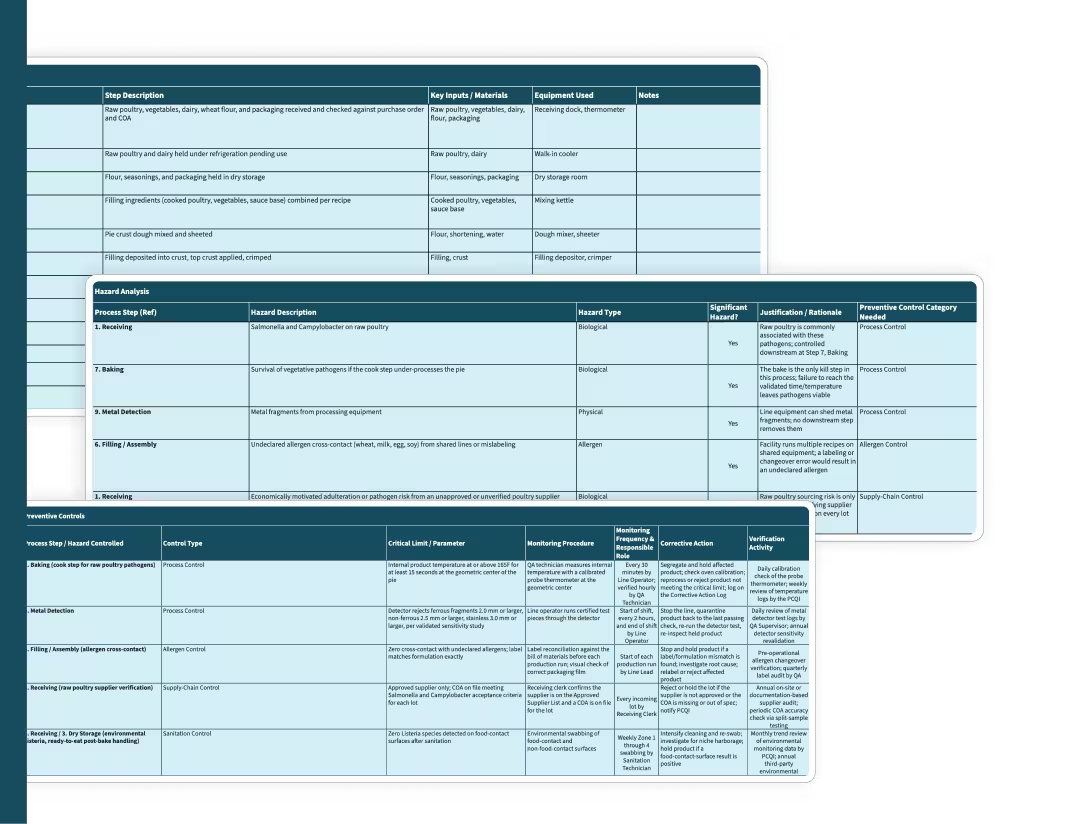
Most physical hazards are controlled by prerequisite programs such as glass control, maintenance hygiene and supplier approval. Detection is where classification gets argued: it is often a CCP, but some plants justify it as an OPRP. If you're asking is metal detection a CCP or an OPRP for your own line, that guide walks through the decision.
"Not reasonably likely to occur" needs evidence
Many plants conclude that foreign material is a hazard but not one reasonably likely to occur, and control it without a CCP. FSIS accepts that with a condition. If the conclusion rests on foreign material never having occurred in that process, "a justification, such as historical data, is required to be available to support that determination" under 9 CFR 417.5(a)(1), and inspectors can ask to see it.
Building a foreign material control program
Every control below needs a check that proves it works, a frequency, and a known failure mode. Write them per line, because a glass-jar filler and a flour sifter share few risks.
Glass, brittle plastic and ceramics
Keep a register of every glass, brittle plastic and ceramic item in or near production, with its location, condition and check frequency. Light covers, gauges, sight glasses and visor screens all belong on it. Audit it on a schedule, for example weekly in open-product areas, and record each item's condition rather than a single tick.
When something breaks, follow the same procedure every time: stop nearby production, cordon off the area, clean up with dedicated equipment, inspect product and surfaces in the zone, dispose of exposed product, and record it. FSSC 22000 guidance states that organizations "must retain records of glass or hard plastic breakage for traceability purposes."
Metal
Metal finds often trace back to the plant itself: worn parts, loose fasteners and debris left after maintenance. Use a tool check-out and check-in record for engineering work, and don't release a line until every tool, nut and offcut is accounted for. Ban wire brushes and steel wool on product-contact equipment. Inspect screens, sieves and blades on a schedule, since a torn mesh is a contamination event nobody has found yet.
Plastic and rubber
Use colored, metal-detectable tools, scrapers and paddles in open-product areas so a broken fragment is both visible and detectable. Replace them on a schedule instead of waiting for them to break. Gaskets, seals and belts wear into product slowly, so include them in preventive maintenance and in the checks on your food contact surfaces.
Wood, pallets and packaging
Keep wood out of open-product areas wherever you can, and document the exceptions. Reject broken pallets at intake. Remove outer packaging before materials enter open-product areas, and control staples, strapping and bag closures at the point of opening.
People
A personal-items policy does most of the work: no jewelry beyond a plain band if you permit one, no pens or phones above open product, blue detectable bandages, and hairnets and beard snoods that cover properly. Check PPE condition as well as presence, since a torn glove is itself a contaminant. Train people on the policy and keep proof that they've read it.
Raw materials and suppliers
Put foreign-material limits in your raw material specifications, and make supplier controls such as sieves, magnets or optical sorting a condition of approval where the material warrants it. Back that up with sieving, magnets and visual checks during receiving inspection, because stones in pulses start at the supplier.
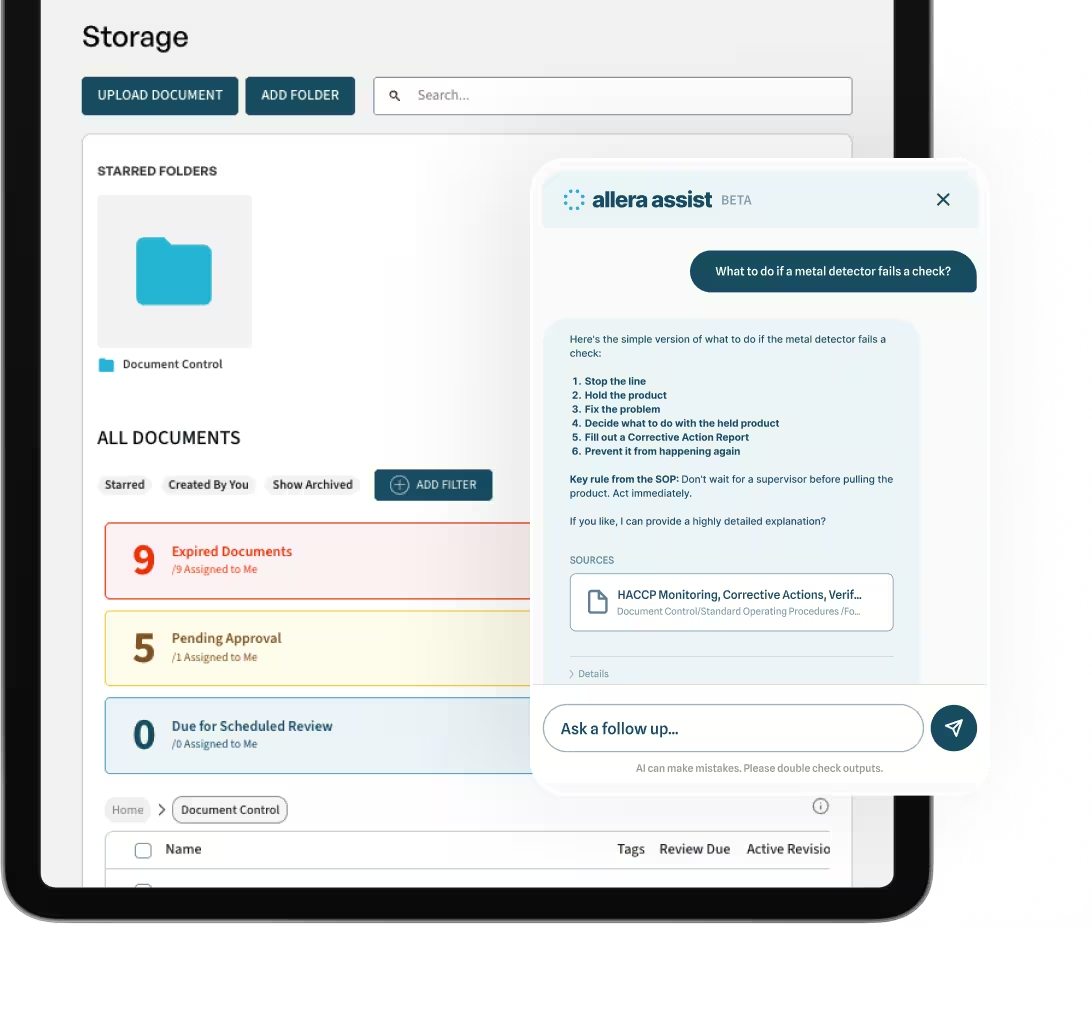
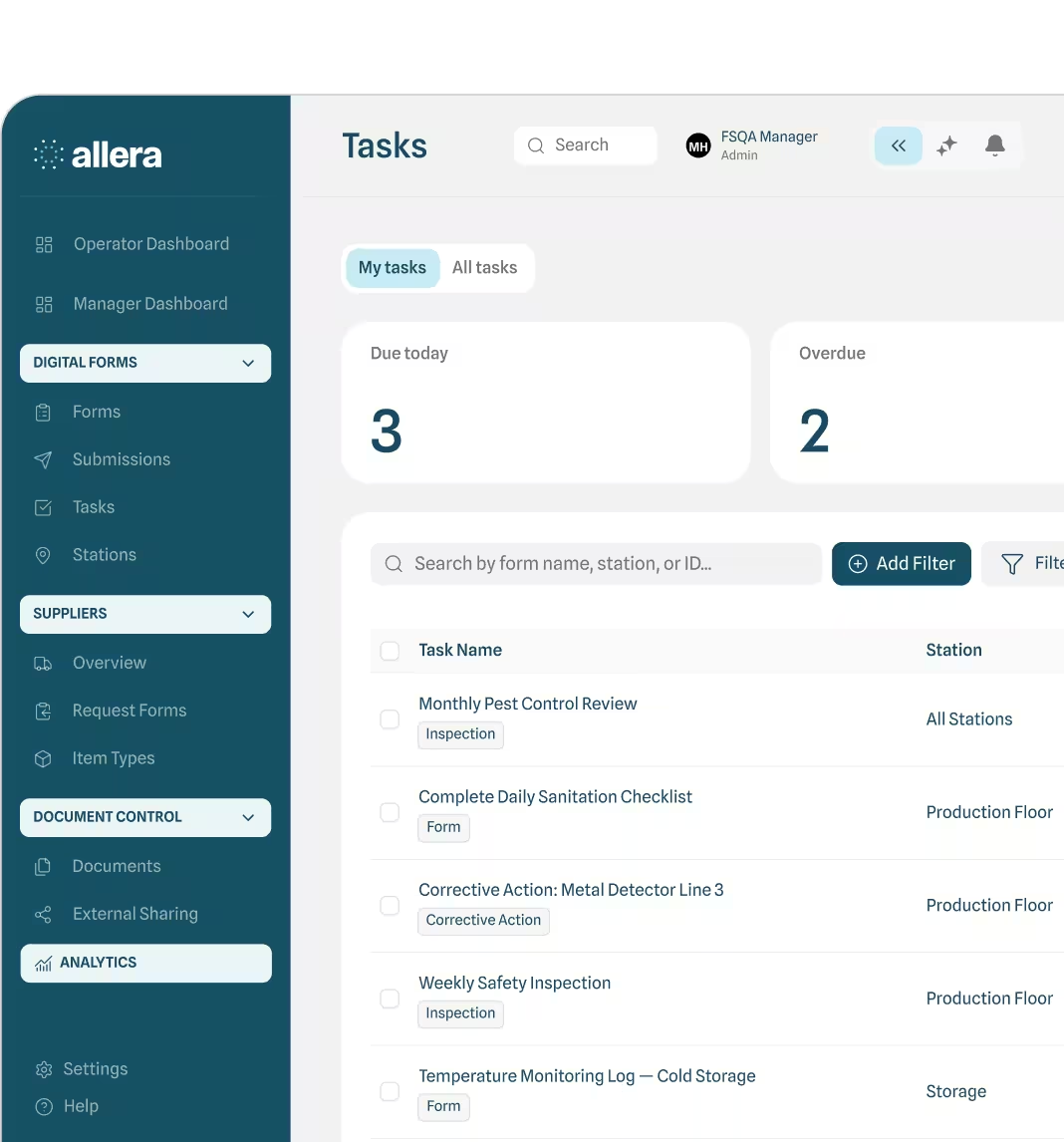
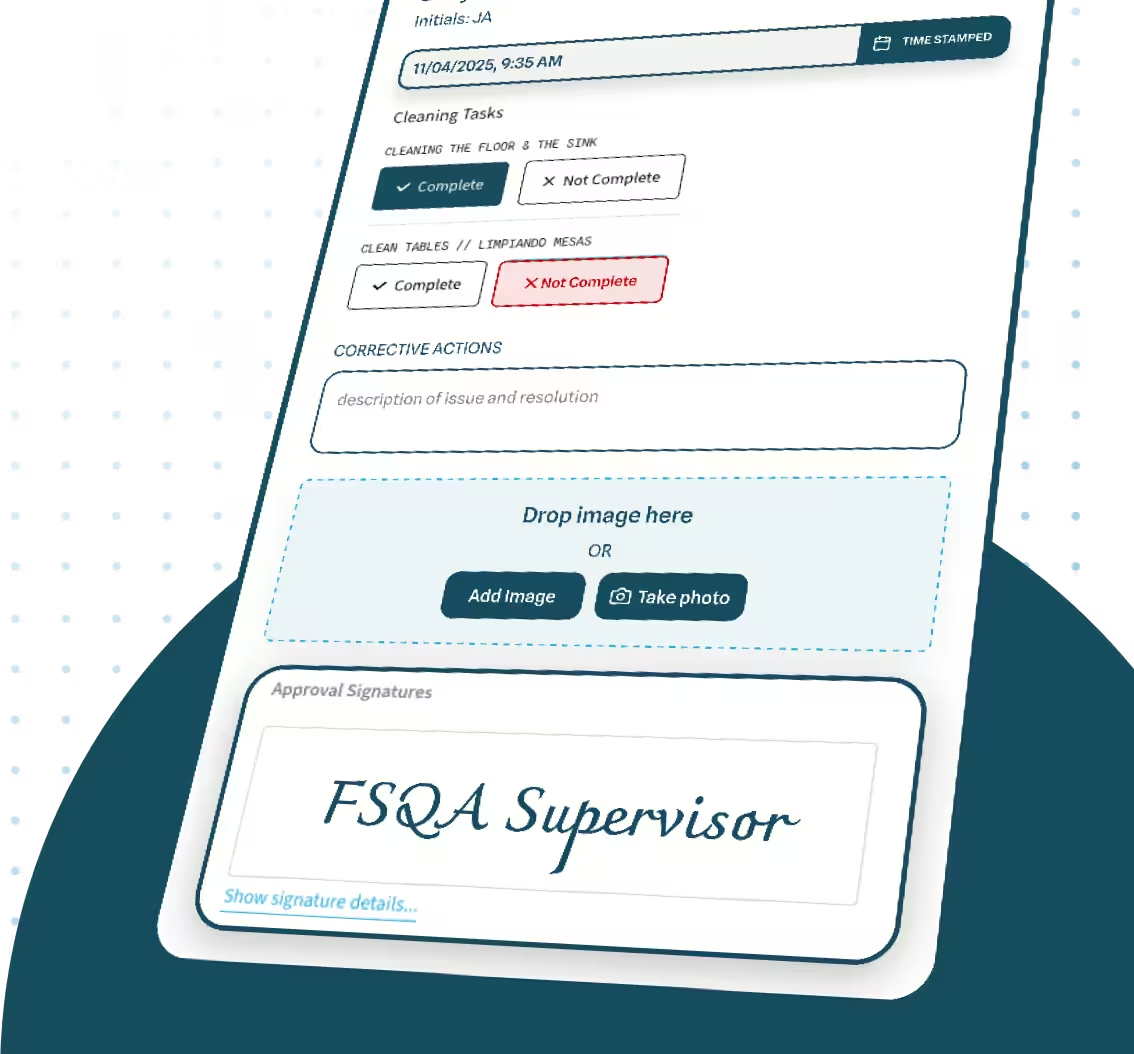
The useful test for any paper-based check is whether a missed or failed one ever reaches anyone. In Allera, you can set glass audits, sieve and magnet inspections and detector checks as recurring Task Instances in Digital Forms, so a missed audit shows as Overdue instead of quietly not happening. A failed check trips a rule that creates a Corrective Action task with an owner. See how Allera handles operational checks.
Detection and removal: the last line, not the first
Detection finds what prevention missed, and every method has blind spots. This table adapts the BRCGS summary of detection technologies:
| Method | What it catches | What it misses |
|---|---|---|
| Visual inspection | Surface contaminants operators can see | Anything hidden. Subjective, prone to fatigue, never 100% inspection |
| Optical sorting | Surface defects and foreign material in free-flowing product | Anything below the surface, and products that don't flow freely |
| Metal detection | Conductive metals | Non-metals and very small fragments. Not suitable for some foods |
| X-ray inspection | A wide range of dense materials, such as metal, glass and stone | Low-density materials such as paper and pests |
| Magnets | Ferrous metals | Anything non-ferrous. Free-flowing product and liquids only |
| Sieves and filters | Oversized particles in free-flowing product and liquids | Anything smaller than the mesh, and a broken screen becomes a contaminant |
A reject tells you something got in but not where from, so treat every reject as a prompt to look upstream. FSIS adds that if foreign material is reasonably likely to occur, you should expect regular rejects and treat them as a process step in your flow diagram. For sensitivity settings and metal detector versus X-ray, see our guide to metal detection in food packaging.
Verification checks that don't create the problem
Test-piece checks carry their own risk. BRCGS reports that "several recalls have been caused by the test product finding its way into the final product or where product in the rejected 'bin' is inadvertently replaced on the production line." Number your test pieces, store them securely and sign them out and back in for every check. Lock reject bins and reconcile what goes in against what gets investigated.
For a worked example that follows one detector, see verifying a metal detector.
When you find foreign material: incident response step by step
A find on the line should trigger the same sequence every time, so write it down before you need it.
- Stop the line and contain the product.
- Put affected lots on hold. The scope runs from the last good check to the find, so your check frequency sets the size of your hold.
- Preserve and photograph the object. Bag it, label it, and record where and when it was found.
- Identify it. Match it against materials in your plant first, and send it to a lab if you can't. Food Safety Magazine describes the lab route, from microscopy to FTIR spectroscopy, elemental analysis and comparison against reference materials.
- Trace the source. Walk the line and check the glass register, maintenance records, recent engineering work and the supplier lots in use.
- Decide product disposition. Assess the held product and document who made the call and why.
- Take corrective action. Fix the root cause and verify the fix, following your corrective action plan. If a supplier caused it, issue a supplier corrective action request (SCAR).
- Record it and trend it. Close the incident with its root cause, then add it to your trend data.
For meat and poultry, FSIS expects an unforeseen foreign material hazard to be handled under 9 CFR 417.3(b), including product disposition and a reassessment of whether the hazard now belongs in your HACCP plan.
Customer complaints
A foreign object found by a consumer starts the same investigation at step 3. Get the object back if you can, identify it, and trace it to a lot and a line. Count them in your trend data, because they are the finds your controls missed.
The records that prove control
Auditors and inspectors want evidence that your controls ran. Expect to show:
- The glass and brittle plastic register, with audit results
- Breakage logs, with clean-up and product decisions
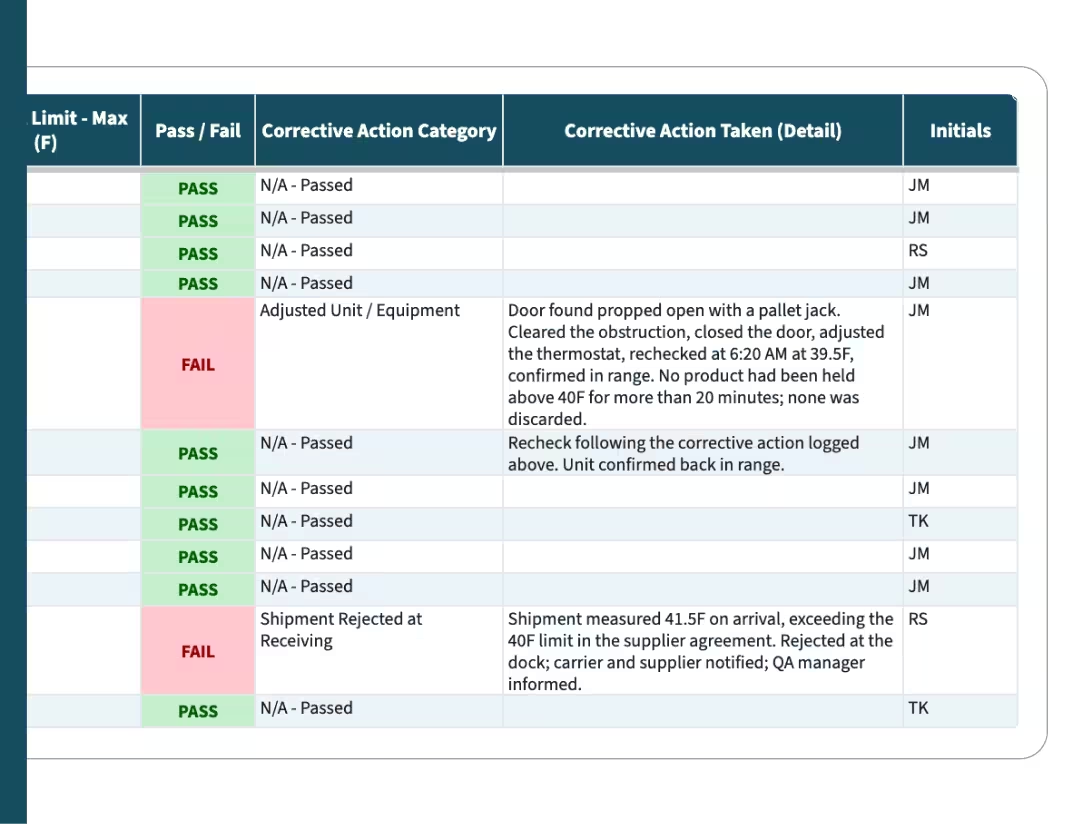
- Detector checks, with test-piece results and reject-bin reconciliation
- Sieve, filter and magnet inspection logs
- Maintenance clearance sign-offs after engineering work
- The incident log, with root cause and closure
- Evidence that someone reviewed all of it
The last item is the easiest to miss, because records get filed and never read. Trending matters too: incidents by line, by contaminant type and by supplier. That is the historical data FSIS asks for behind a "not reasonably likely to occur" decision.
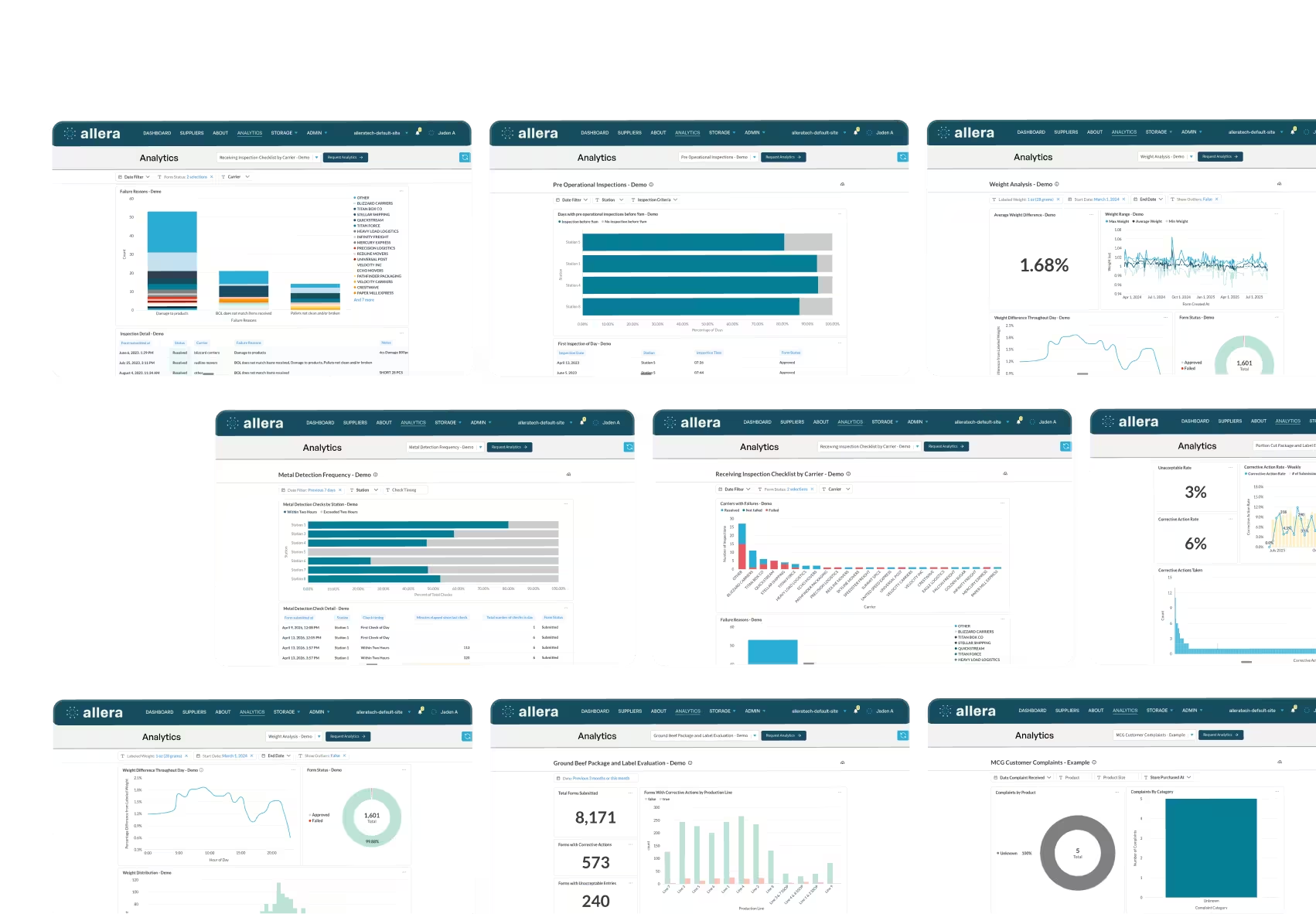
In Allera, each foreign material check and incident is a Form Submission you can filter by Site, show contaminant type as a column, save as a view and export as PDFs for your auditor. An incident form can carry an Image field for the photo of the object, and assigned approvals mean QA signs it off before it clears. Allera is the record, verification and follow-up layer around your detection equipment: operators record the checks, and the platform handles the schedule, the follow-up and the evidence. See how Allera turns checks into records you can defend.
What each certification scheme requires
No scheme uses the phrase "physical contamination program," but all of them expect one. Treat this as a starting map, and check your scheme's current text before you cite a clause.
| Framework | Where it lands | What it expects |
|---|---|---|
| FSMA / 21 CFR 117 | 117.130(b)(1)(iii) hazard analysis; 117.80(c)(8) CGMPs | Physical hazards in the hazard analysis, and adequate measures against metal and extraneous material |
| USDA FSIS | Directive 7310.5; 9 CFR 417 | Foreign material in the hazard analysis, with CCPs where it is reasonably likely to occur and supporting records where it isn't |
| SQF Food Manufacturing, Edition 10 | Foreign matter requirements in the code | Foreign matter prevention and detection, including glass and brittle material control. Confirm element numbers against Edition 10 |
| BRCGS Food Safety Issue 9 | 4.9 chemical and physical product contamination control; 4.10 foreign-body detection and removal equipment | Risk-based controls for glass, brittle plastic, wood and other foreign materials, plus verified detection and removal equipment |
| FSSC 22000 Version 6 | Additional Requirement 2.5.11(d), with PRPs under ISO 22002-1 | A risk assessment for the need and type of detection equipment, a procedure for its use, and procedures for all breakages |
The common thread is a documented risk assessment, controls that match it, and reviewed records proving they ran.
Physical vs. chemical vs. biological contamination (and allergen cross-contact)
FDA's hazard analysis rule, 21 CFR 117.130, names three hazard types and classes food allergens as chemical hazards. Many training frameworks list allergens separately, which is why you see four or five "types" of contamination.
| Type | Examples | Typical controls | Usually found by |
|---|---|---|---|
| Physical | Glass, metal, hard plastic, stone, bone | Glass control, maintenance hygiene, sieves, magnets, detection | Detectors, inspection, complaints |
| Chemical | Cleaning residues, pesticide residues, natural toxins | Chemical control, supplier approval | Lab testing |
| Biological | Listeria, Salmonella, E. coli O157:H7 | Cooking, cold chain, sanitation | Microbiological testing |
| Allergen cross-contact | Peanut residue on a shared line | Scheduling, changeover cleaning, labeling | Allergen-specific tests |
For the other types, see our guides to chemical hazards in food, preventing biological hazards and allergen cross-contact.
Intentional physical contamination
Everything above assumes the contamination is accidental. Deliberate tampering, such as needles or glass placed in product, is a food defense problem, and GMP controls weren't designed to stop someone who is trying. Handle it in your food defense plan, and make sure a find that matches nothing in your plant or supply chain can trigger that plan.
Allera handles the record side of a physical contamination program: recurring checks in Digital Forms, your foreign material SOP and glass policy on Scheduled Review in Document Control, and supplier foreign material statements collected and renewed through Request Forms. See how Allera supports your food safety program.
FAQs
Is metal detection required by the FDA?
Not by name. The CGMPs in 21 CFR 117.80(c)(8) require "adequate measures" against metal and other extraneous material, and your hazard analysis decides which measures fit, whether that's metal detection, X-ray, magnets or sieves. Your customers or certification scheme may still expect detection, and FSSC 22000 requires a documented risk assessment of whether you need detection equipment. Our guide to metal detection in food packaging covers the detail.
What size of foreign object does FDA consider a hazard?
Under FDA's CPG Sec. 555.425, a hard or sharp foreign object of 7 to 25 mm in a ready-to-eat or minimal-preparation food makes that food adulterated. Objects over 25 mm, objects of 7 to 25 mm in products that need further processing, and objects under 7 mm in food intended for special-risk groups such as infants, surgery patients or the elderly go to a case-by-case FDA health hazard review. These sizes are FDA's enforcement line, so set your detector sensitivity through validation and customer specification instead.
Are microplastics physical contamination?
Generally not, for HACCP purposes. Microplastics and plasticizers are usually treated as an emerging chemical and environmental issue rather than a foreign-object hazard, partly because you can't see, detect or remove them the way you can a plastic fragment. Visible pieces of plastic from equipment, tools or packaging are physical contamination and belong in your foreign material program. For a broader view, see our piece on microplastics.
Is hair a physical contaminant?
Yes. ServSafe's definition of physical contaminants includes hair, and it belongs in the "people" source of any foreign material program. Hair is unlikely to cause serious injury, but it makes food objectionable to the consumer who finds it, so you control it with hairnets, beard snoods, PPE in good condition and good changing-room practice.
What are the 6 Ps of physical contamination?
The 6 Ps are a UK training framework that groups the sources of physical contamination: people, premises, plant, packaging, pests and products. People covers hair, jewelry and bandages, premises covers flaking paint and light-fitting glass, and plant covers equipment fragments such as bolts and wire. Packaging, pests and raw-material products such as stones and bone complete the list, and each P points you to a different set of controls.
What are the 5 types of food contamination?
Frameworks count differently. FDA's hazard analysis rule, 21 CFR 117.130, names three hazard types: biological, chemical (which includes allergens and radiological hazards) and physical. Training courses often list four by treating allergens separately, and the fifth varies from course to course. Whichever list you use, your hazard analysis has to cover every one of them.
What is an example of a physical contaminant according to ServSafe?
The ServSafe glossary defines physical contaminants as objects such as hair, dirt, metal staples and broken glass, as well as bones in fillets, that have contaminated food. If you work in manufacturing rather than foodservice, the same objects apply. You'll also need to control plant-specific sources such as equipment wear, maintenance debris and packaging.
What are examples of physical contamination?
Common examples include glass shards, metal fragments such as nuts, bolts and wire, hard plastic, rubber from worn gaskets and belts, wood splinters, stones, bone and shell, and personal items such as jewelry, bandages and hair. The easiest way to list the ones that apply to you is to walk your plant by source: people, premises, plant, packaging, pests and products. Each source points you to a different control, from a glass register to tool checks after maintenance.

.avif)
.avif)
.avif)

.avif)
%20(1).avif)
.avif)
.avif)

%20(1).png)

.avif)



.avif)