.avif)



Chemical Hazards in Food: Types, Examples and Controls for Manufacturers

In a November 2025 milk recall for food-grade cleaning agents, Prairie Farms pulled gallon jugs of fat-free milk made at its Dubuque, Iowa plant. About 320 gallons had sold before the issue was discovered. Most chemical hazards in food look like that on a plant floor: a risk from an everyday chemical you use on purpose.
This guide is for US food manufacturers: how 21 CFR 117 defines chemical hazards, ten examples sorted by where they enter, the controls that keep them out, and what your auditor will check.
Worker exposure to chemicals falls under OSHA's Hazard Communication Standard. Everything below is about keeping chemicals out of food.
What is a chemical hazard in food?
A chemical hazard in food is any chemical substance that can make food unsafe to eat, whether it occurs naturally, gets in by accident or is added deliberately. Chemical hazards in food include cleaning residues, lubricants, allergens, pesticide residues, heavy metals, natural toxins and unapproved additives.
The US definition sits in 21 CFR 117.130, the hazard analysis requirement for human food: "Chemical hazards, including radiological hazards, substances such as pesticide and drug residues, natural toxins, decomposition, unapproved food or color additives, and food allergens."
Chemical hazard vs. chemical contamination
The hazard is the substance: peracetic acid, aflatoxin, undeclared milk protein. Chemical contamination is the event, when that substance reaches food it shouldn't be in.
You manage hazards by deciding which chemicals are allowed on site, and you prevent chemical contamination of food by controlling how those chemicals are stored, applied, rinsed and verified.
Where chemical hazards sit among the types of food safety hazards
Food safety hazards are usually grouped into four types: biological, chemical, physical and economically motivated adulteration. That's the framing in our guide to hazard analysis, and it follows 21 CFR 117.130: paragraph (b)(1) names three categories (biological, chemical including radiological, and physical), and (b)(2) also covers hazards intentionally introduced for economic gain, which is why US programs treat adulteration as the fourth.
UK-style hygiene training often counts allergens as the fourth type instead. Under the US rule, allergens sit inside the chemical category. For the other categories, see our guides to preventing biological hazards and physical contamination.
10 chemical hazards in food, with examples
Sort chemical hazards by where they enter. Hazards 1 to 6 start inside your plant and fall under your own programs. Hazards 7 to 10 arrive with raw materials and packaging, so their controls sit with your supply-chain program.
| Hazard | Examples | Route into product | Typical control | Owner |
|---|---|---|---|---|
| Cleaning and sanitizing chemicals | Caustic, acid, quats, chlorine, peracetic acid | Short rinse, poor draining, over-strength mix | Concentration and rinse checks | Sanitation |
| Maintenance chemicals | Lubricants, hydraulic fluid, boiler additives | Drips, leaks, over-greasing | H1 lubricants, lube-point register | Maintenance |
| Allergens | Milk, egg, peanut, sesame | Changeover cross-contact, wrong label | Allergen control program | QA and production |
| Additives | Preservatives, fortificants, colors | Dosing or formulation error | Batching checks, critical limits | Production |
| Process contaminants | Acrylamide, PAHs, furan, 3-MCPD | Formed by heat or oil refining | Process parameters | Production |
| Pest-control chemicals | Rodenticides, insecticides | Use or storage near product | Approved pesticide list | Pest contractor |
| Pesticide and drug residues | Residues on grain, produce, milk, meat | Arrive in raw materials | Supplier specs, testing | Purchasing |
| Heavy metals, environmental contaminants | Lead, arsenic, cadmium, mercury, PFAS | Soil, water and air | Supplier approval, testing | QA |
| Natural toxins and mycotoxins | Aflatoxin, patulin, scombrotoxin | Mold growth, fish temperature abuse | Specs, action levels | QA and receiving |
| Adulterants and packaging migrants | Lead chromate in spices | Upstream fraud, unsuitable packaging | Vulnerability assessment | Purchasing and QA |
Hazards you introduce inside the plant
1. Cleaning and sanitizing chemicals. These become a hazard when a rinse is cut short, a line isn't drained, or a solution is mixed too strong.
Case: Prairie Farms, November 2025. FDA's notice names no cause, only that the milk "may contain food-grade cleaning agents." The lesson is the controls: verified rinses, verified concentrations and records someone reviews.
2. Maintenance chemicals. Lubricants drip, leak or get over-applied above open product, and boiler water additives reach it through steam.
3. Allergens through cross-contact. Residue from a previous product at changeover, in rework or through the wrong packaging.
4. Food additives over the limit, or unapproved. A fortificant added far above the label rate, a preservative double-dosed at batching, or a color additive not authorized for the use.
Case: niacin over-enrichment, 2013. FDA's CORE Network was notified of illnesses in schools and institutions in Texas, Illinois and North Dakota. People reported redness, flushing and rashes after eating an infused rice product, and FDA testing found niacin far above the labeled amounts. In all, 81 cases were identified.
5. Process contaminants. Acrylamide, polycyclic aromatic hydrocarbons (PAHs), furan and 3-MCPD form during frying, baking, roasting, smoking or oil refining. FDA sets no action level for acrylamide, only 2016 guidance on reducing it, so process parameters are your control.
6. Pest-control chemicals. Rodenticides and insecticides used or stored near exposed product.
Hazards that arrive with your raw materials and packaging
7. Pesticide and veterinary drug residues. EPA sets pesticide tolerances, the maximum amount allowed to remain in or on a food, and your supplier specifications should reference them.
8. Heavy metals and environmental contaminants. Lead, arsenic, cadmium, mercury, PFAS and dioxins are taken up from soil, water and air. FDA's pages on environmental contaminants in food cover each one.
9. Natural toxins and mycotoxins. Aflatoxin and patulin come from mold, and scombrotoxin and ciguatoxin occur in fish. FDA's action levels for poisonous or deleterious substances set 20 ppb for aflatoxin in most human foods.
10. Economically motivated adulteration and packaging migrants. Migrants come from unsuitable packaging. Adulterants are the hardest to catch, because the paperwork can look perfect. Your food fraud vulnerability assessment decides which ingredients deserve extra verification.
Case: lead chromate in cinnamon applesauce, 2023. As of March 22, 2024, CDC had counted 519 cases across 44 states plus Washington D.C. and Puerto Rico. Samples of the cinnamon tested at 5,110 ppm and 2,270 ppm lead. FDA's investigation of lead chromate in cinnamon applesauce pouches gives its leading hypothesis as "likely an act of economically motivated adulteration."
The most harmful chemicals in food, and the ones that actually recall products
It depends on scale. WHO's June 2026 foodborne disease estimates put the global toll of unsafe food at 866 million illnesses and 1.5 million deaths a year. In 2021, chemical hazards accounted for 73% of deaths from contaminated food, mostly linked to inorganic arsenic (42%) and lead (31%), largely because these exposures raise the risk of heart disease and cancers.
Those are global figures across 194 countries, driven by long-term dietary exposure. They don't describe the risk on your production floor.
In the US, FDA's review of chemical foodborne incidents, 2011 to 2025 found that 127 of the 1,270 incidents its CORE Network evaluated (10%) were chemical. Of those, 102 (80%) involved fish and shellfish toxins, and only one was a food additive: the niacin case above.
For a manufacturer, the chemical hazards behind recalls tend to be more ordinary. FDA reports that from September 2009 to September 2014, about one-third of foods reported to the Reportable Food Registry as serious health risks involved undeclared allergens, and milk is the most common cause of undeclared-allergen recalls. Cleaning agents reaching product, supplier-borne contaminants and formulation errors are the other recurring routes, as the three cases above show.
How 21 CFR 117 handles chemical hazards in your hazard analysis
Your written hazard analysis has to identify known or reasonably foreseeable hazards for each type of food you make, whether they occur naturally, are introduced unintentionally or are introduced for economic gain. You then evaluate each for severity and for the probability it will occur in the absence of preventive controls.
Don't start from a blank sheet. Appendix 1 of FDA's draft Hazard Analysis and Risk-Based Preventive Controls guidance tabulates known or reasonably foreseeable hazards across more than 200 pages, so work from the chemical hazards listed for your products.
Preventive control or CCP? Which chemical hazards need which
Most plant-side chemical hazards are managed through CGMPs and prerequisite programs under 117.35, or as sanitation and allergen preventive controls. Supply-side hazards are usually handled by your supply-chain program when a supplier controls them.
The main exception is an additive with a regulatory maximum that you dose yourself, where a process control with a critical limit at batching fits. For a mycotoxin and pesticide residue example, see our critical control point examples.
Building a chemical control program
A chemical control program governs every non-food chemical from purchase to disposal. It usually sits inside your cleaning and sanitation program, and six elements carry most of the weight.
The approved chemical list
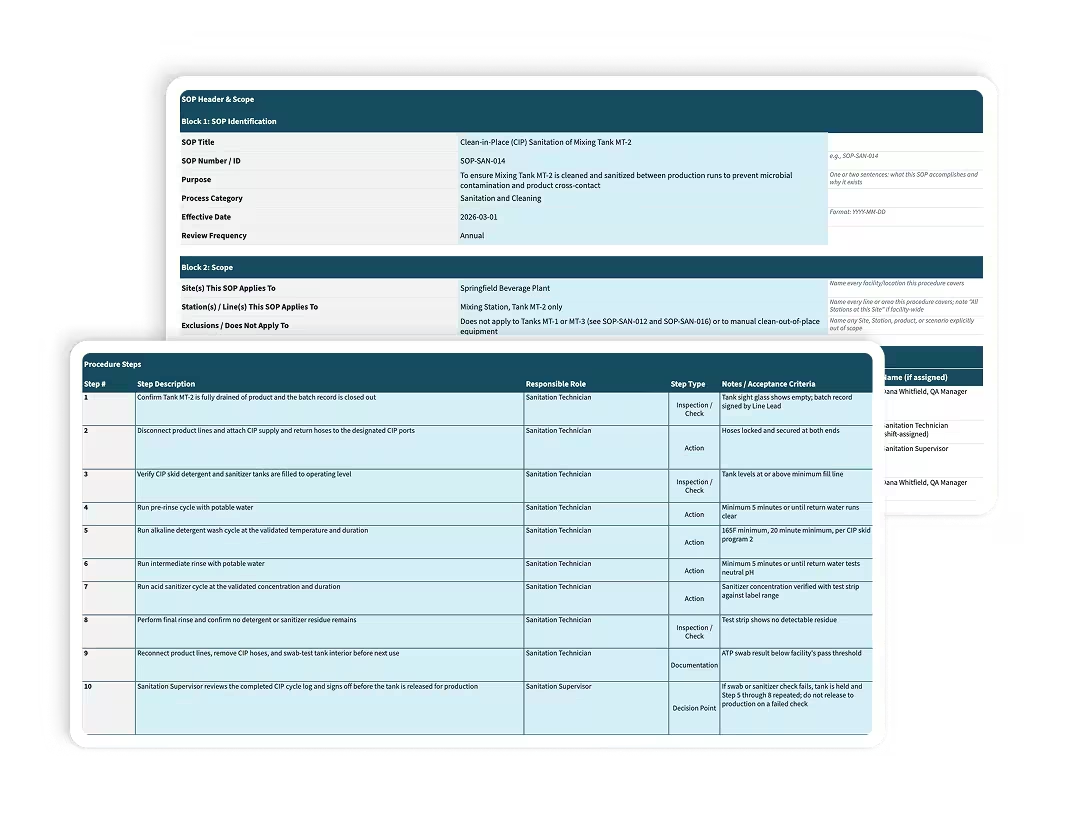
Keep one list of every chemical permitted on site, recording the product and supplier, its use and location, the dilution, food-contact suitability and the evidence for it, the SDS revision date and an owner.
Tie each entry to a purpose. 21 CFR 117.35(b)(1) says "only the following toxic materials may be used or stored in a plant where food is processed or exposed," then lists four groups: those for clean and sanitary conditions, laboratory testing, plant and equipment maintenance and operation, and plant operations. A chemical that fits none of them doesn't belong on the list.
Segregated storage
117.35(b)(2) requires toxic cleaning compounds, sanitizing agents and pesticide chemicals to be "identified, held, and stored in a manner that protects against contamination of food, food-contact surfaces, or food-packaging materials." In practice that means a designated, locked area with spill containment, away from ingredients and packaging. Keep chemicals used as ingredients, such as food-grade acids and bases, apart from cleaning chemicals too, which BRCGS Issue 9 also expects.
Decanting and secondary-container labeling
Never put chemicals into food containers, and label every spray bottle and bucket with the product and its use concentration. Color coding helps people grab the right container, but it doesn't replace a label.
Concentration verification
Sanitizer concentration fails in both directions: too strong leaves residue on food contact surfaces, and too weak leaves a microbiological hazard on a surface recorded as sanitized. 21 CFR 178.1010 allows sanitizing solutions on food-contact equipment when they're used "followed by adequate draining, before contact with food," within the limits it sets for each formulation.
Check concentration at the point of use with test strips or titration, at a frequency set in your sanitation standard operating procedures (SSOPs), and record the reading, time, person and any action taken. After clean-in-place (CIP), final-rinse pH or conductivity checks confirm the chemistry has cleared. Keep test strips in date, because an expired strip still gives a reading you can't trust.
SDS control, and why an SDS isn't proof of food safety
A safety data sheet is a worker-safety document under OSHA's Hazard Communication Standard (29 CFR 1910.1200). It tells staff how to handle the product safely. It isn't designed to show whether the product suits a food-contact surface.
Keep the SDS current, and file the food-contact evidence alongside it: label directions for food-contact use, EPA registration for sanitizers, an NSF registration, or a supplier letter.
Chemical deliveries, spills and obsolete stock
Check chemical deliveries against the approved list during receiving inspection, and reject anything unapproved or unlabeled. Write down how a spill is contained and who decides whether nearby product is affected. BRCGS Issue 9 also expects procedures for disposing of or returning out-of-date chemicals and empty containers.
A chemical control program runs on documents: the approved list, the SDS set and the evidence behind each approval. Allera's Document Control keeps them under version control with approval workflows, a Scheduled Review for the annual re-approval, and acknowledgment tracking for the chemical-handling SOP. See how Allera manages controlled documents.
Food-grade lubricants: H1, H2, 3H and H3 explained
Food-grade lubricant categories come from NSF's Nonfood Compounds Registration Program, which NSF introduced in 1999 after USDA discontinued its own authorization program.
| Category | What it's registered for |
|---|---|
| H1 | Lubricants for use where incidental food contact is possible |
| H2 | Lubricants for equipment with no possibility of food contact, such as closed systems |
| 3H | Release agents approved for direct contact with food |
| H3 | Soluble oils used to prevent rust on hooks, trolleys and similar equipment |
H1 means incidental contact, which isn't permission to over-grease. 21 CFR 178.3570 requires these lubricants to be made from permitted substances, several with a 10 parts per million limit in food, and used at "the minimum required to accomplish the desired technical effect on the equipment."
To check a product, search NSF's certified product listings (the Nonfood Compounds White Book) and confirm the category code fits the use. Then keep a lube-point register naming the approved product for every point, use dedicated or color-coded grease guns so H2 never reaches an H1 point, and put contractor lubricants on your approved list. Boiler water additives in steam that contacts food fall under 21 CFR 173.310.
Allergens: why they're classed as a chemical hazard
21 CFR 117.130 names food allergens as a chemical hazard. The US has nine major food allergens: milk, eggs, fish, crustacean shellfish, tree nuts, peanuts, wheat, soybeans and sesame, which became the ninth effective January 1, 2023 under the FASTER Act.
The chemical framing matters because cooking or pasteurizing won't reliably make an allergen safe. Control depends on segregation, validated changeover cleaning and label control, and allergen swabs are chemical tests. Your allergen control program holds those controls, and our guide to allergen cross-contact covers changeover in depth.
Supplier controls for chemical hazards: what a CoA can and can't prove
When a supplier controls a chemical hazard before the material reaches you, such as pesticide residues, heavy metals or mycotoxins, the supply-chain program in 21 CFR 117 Subpart G applies: approved suppliers, verification activities matched to the hazard, and records of both. Your supplier approval program documents the approval decision.
A useful chemical certificate of analysis is lot-specific and names the method, detection limit and laboratory. Compare it with FDA action levels, EPA tolerances and your own specification.
The lead chromate case shows the limit: a CoA only answers the questions you asked. High-risk ingredients, such as spices and the rice-based and juice ingredients in foods for young children, justify periodic independent testing alongside the paperwork.
When to test for chemical hazards, and for what
Test when you approve a new supplier or origin, where your hazard analysis calls for verification, and after any incident. Match the panel to the hazard: heavy metals for spices and rice, mycotoxins for grains and nuts, pesticides for produce. See our guide to chemical contaminant testing.
What auditors check on chemical control
Each scheme files chemical control in a different place, but they expect the same core controls.
| Framework | Where chemical control sits | What the auditor looks for |
|---|---|---|
| 21 CFR 117 | 117.35, 117.130, Subpart G | Only necessary chemicals on site, protected storage, chemical hazards in the hazard analysis, supplier verification |
| SQF Food Manufacturing Code, Edition 10 | GMP requirements for hazardous chemicals and toxic substances | Controlled storage and handling |
| BRCGS Food Safety, Issue 9 | Section 4.9, chemical and physical product contamination control | Managed chemical use and storage, spill procedures, disposal of obsolete chemicals and empty containers |
FSSC 22000 sites meet the same expectations through their prerequisite programs. Common findings:
- Unlabeled spray bottles
- Unapproved chemicals in the cage
- Expired test strips
- Concentration logs showing the same value every day
- H2 grease where H1 is required
- An out-of-date SDS binder
- No evidence anyone reviewed the concentration logs
The last one is the hardest to fix on paper. A log that's filed but never reviewed lets an out-of-range reading sit until the auditor finds it, and a corrective action plan that starts then is already late.
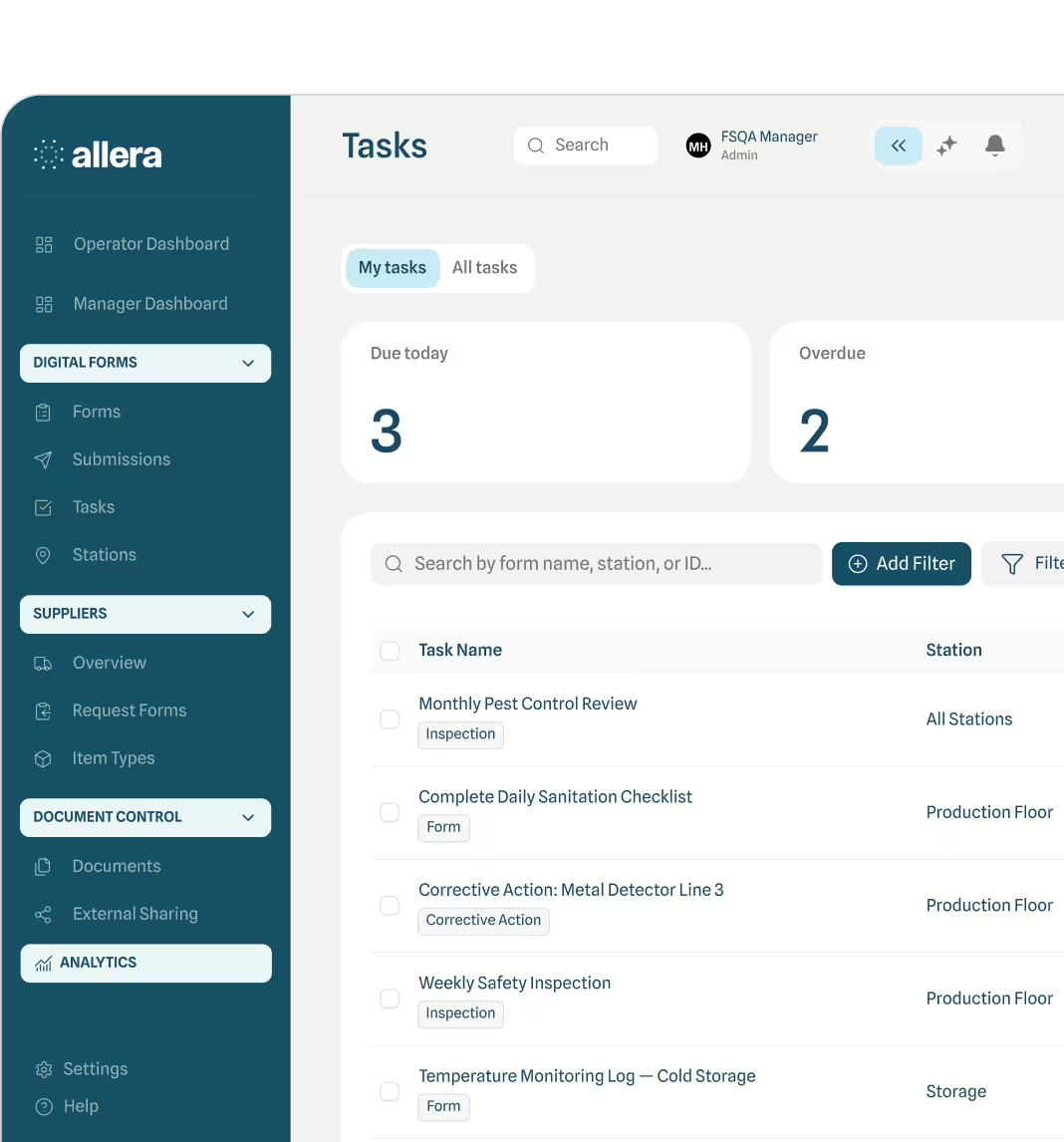
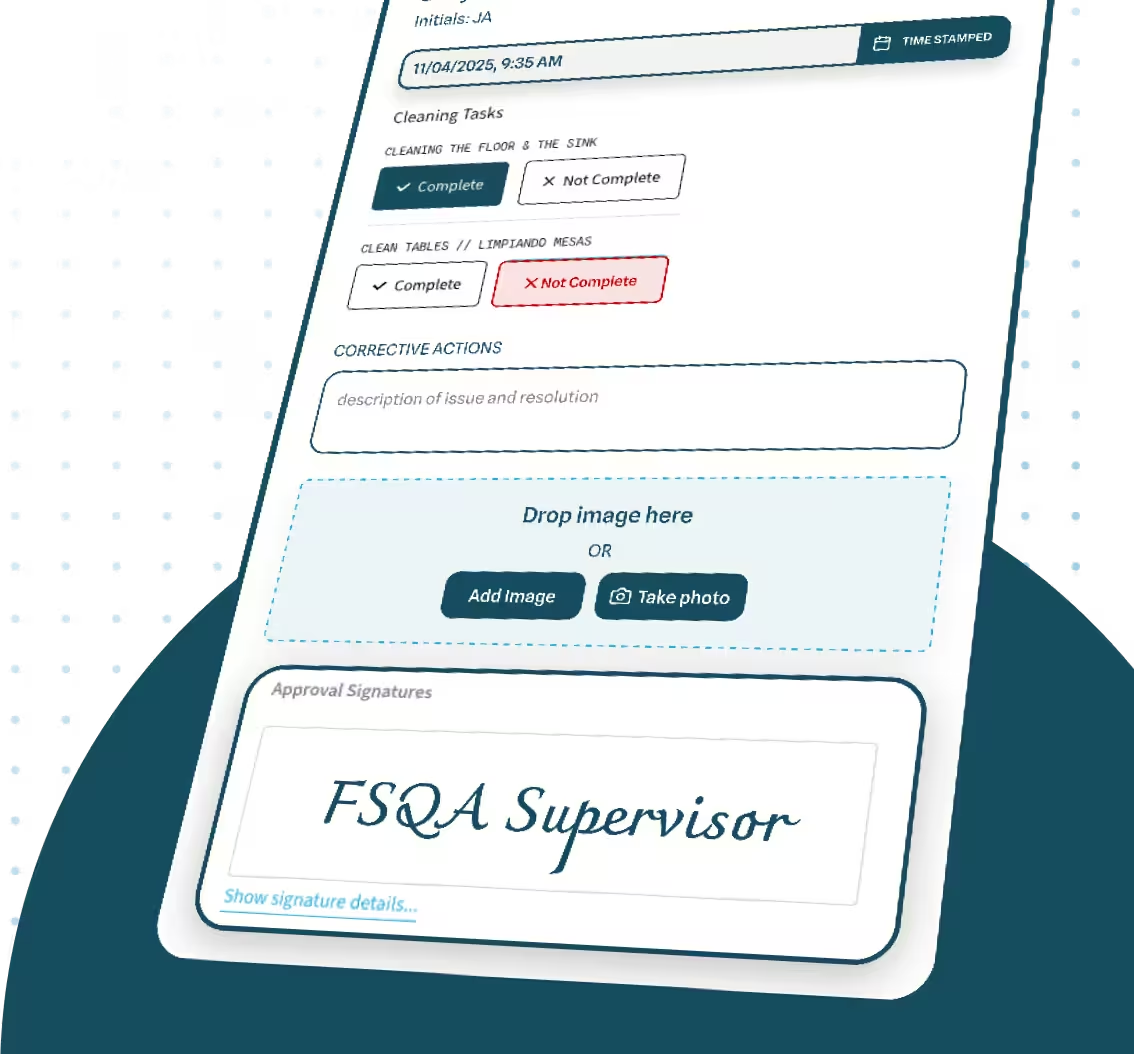
Allera's Digital Forms can run the daily concentration check on a recurring Task schedule. An out-of-range reading trips a failure rule that creates a Corrective Action task with an owner, and each Task Instance shows as Completed On Time, Completed Late, Overdue or Skipped. Your Operator enters the reading, since Allera doesn't connect to dispensers, titrators or sensors. See how Allera handles operational checks.
What's changing in 2026 and 2027: additives and contaminants to watch
Four developments to track. All of them move, so check the agency pages before acting:
- FDA's post-market chemical review. On May 12, 2026, FDA finalized a process for reassessing chemicals already in the food supply and began reassessing BHT and azodicarbonamide (ADA). FDA's food chemical safety page links its public list of chemicals under review.
- FD&C Red No. 3. FDA revoked its authorization on January 15, 2025, and food manufacturers must reformulate by January 15, 2027.
- Lead in baby food. In January 2025, FDA issued final guidance on action levels for lead in processed foods for babies and young children, under its Closer to Zero program.
- California. The California Food Safety Act bans four additives, including Red No. 3, from January 1, 2027.
Chemical controls rarely fail dramatically. They fail through a rinse cut short, an unlabeled spray bottle, a CoA that never tested for the adulterant, or a log nobody reviewed. When you're ready to move those checks off paper, see how Allera turns chemical control records into evidence you can defend.
FAQs
How often should sanitizer concentration be checked?
Set the frequency by risk in your SSOPs, checking wherever the concentration can drift. Hand-mixed solutions need checking each time they're made up, while dispenser output can be checked on a set schedule and after any maintenance or chemical changeover. Record the reading, the time, who checked it and what you did about any out-of-range result, because an unrecorded check is hard to defend at audit.
Is a safety data sheet enough to prove a chemical is food-safe?
No. A safety data sheet is an OSHA hazard communication document that tells your staff how to handle a chemical safely. To show a product is suitable for food-contact use, you also need evidence such as the label's food-contact directions, EPA registration for a sanitizer, an NSF registration or a letter from the supplier.
What is the difference between H1 and H2 lubricants?
H1 lubricants are registered for use where incidental food contact is possible, and they're made from substances permitted under 21 CFR 178.3570. H2 lubricants aren't food grade and are only for equipment with no possibility of food contact, such as closed systems. You can check a product's category in NSF's Nonfood Compounds listings, and you should use H1 at any lube point above or near exposed product.
Are allergens a chemical hazard?
Yes. 21 CFR 117.130 lists food allergens among chemical hazards, alongside pesticide and drug residues, natural toxins and unapproved additives. Cooking or pasteurizing won't reliably make an allergen safe, so you control allergens through segregation, validated changeover cleaning and label control. The US has nine major food allergens, with sesame added effective January 1, 2023.
What are the four types of food hazards?
The four types are biological, chemical, physical and economically motivated adulteration. 21 CFR 117.130 names the first three as hazard categories and also requires you to consider hazards intentionally introduced for economic gain. Under the US rule, radiological hazards and food allergens both sit inside the chemical category, although some UK-style training lists allergens as a separate fourth type.
What are the most harmful chemicals in food?
Globally, inorganic arsenic and lead do the most harm. WHO's June 2026 estimates found that chemical hazards caused 73% of deaths from contaminated food in 2021, mostly linked to inorganic arsenic (42%) and lead (31%), largely because long-term exposure raises the risk of heart disease and cancers. Those are global figures, though. For a US manufacturer, the chemical hazards that typically reach your product are more everyday: undeclared allergens, cleaning agents, supplier-borne contaminants and dosing errors.
What are 5 examples of chemical hazards?
It depends on whether you mean hazards to food or to your workers. In food, five examples are sanitizer residues, lubricant drips, undeclared allergens, pesticide residues and aflatoxin. In the workplace, examples include corrosive cleaners, chlorine gas released by mixing incompatible chemicals, ammonia refrigerant and solvents, which fall under OSHA's Hazard Communication Standard.
What are 5 examples of chemical hazards in food?
Five common examples are cleaning and sanitizer residues, lubricant drips from equipment, undeclared allergens, pesticide residues on raw materials, and mycotoxins such as aflatoxin in grains and nuts. Heavy metals like lead and arsenic, process contaminants like acrylamide, and additives used above their permitted level are chemical hazards too. It helps to sort them by whether you introduce them in your plant or they arrive with your raw materials, because the controls differ.
.avif)
.avif)
.avif)
.avif)
%20(1).avif)
.avif)
.avif)

%20(1).png)

.avif)



.avif)