.avif)



GFSI vs. SQF vs. BRCGS: How to Choose a Food Safety Certification

A customer sends an email asking for your GFSI certification, and someone in your building now has to work out what to buy. That is how most people arrive at the GFSI vs SQF question, and the answer usually surprises them.
You cannot buy GFSI certification. It does not exist as a thing you can hold. What you can hold is certification to a scheme that GFSI recognises, and SQF and BRCGS are two of them.
The short answer
GFSI is not a certification. The Global Food Safety Initiative is a benchmarking body that sets requirements a certification scheme must meet in order to be recognised. SQF and BRCGS are certification schemes. You get certified to one of them, and that certification is accepted as GFSI-recognised.
So "GFSI vs SQF" is not a comparison between two options. The real choice is between the recognised schemes: SQF, BRCGS, FSSC 22000, IFS, PrimusGFS, and others.
The phrase "GFSI certification" persists anyway, and it is harmless shorthand once everyone knows what it means. When a customer uses it, they are asking you to hold certification to a GFSI-recognised scheme, usually without a strong opinion about which one.
"My customer asked for GFSI certification"
Before you choose anything, go back to them. Three questions save you an entire certification cycle if the answer is unexpected.
Do you require a specific scheme? Many large buyers do, and they simply did not say so. Retailers with established supplier programs often have a preference documented somewhere neither of you has looked.
Do you have an approved scheme list? Some buyers accept any GFSI-recognised scheme. Others accept three of them. The list is usually in the supplier manual.
Does your own customer impose one? If your buyer is a co-manufacturer or distributor rather than the end retailer, the requirement may be passed down from someone further along the chain, and matching that scheme avoids a second certification later.
Asking costs a day. Choosing wrong costs a year and the cost of the audit.
What GFSI actually does
GFSI benchmarks. It does not audit facilities, issue certificates, or accredit certification bodies. It publishes requirements that a certification scheme owner has to demonstrate their scheme meets, and it recognises schemes that do.
The value of that is practical. Before benchmarking existed, a manufacturer supplying several major retailers could face several different food safety audits covering substantially the same ground. Recognition means a single certification to a recognised scheme is broadly accepted, so audits are not duplicated across customers.
The current requirements are set out in the GFSI Benchmarking Requirements, and the recognition process explains how a scheme owner achieves and maintains it.
Scope of recognition is not all-or-nothing
This is the detail that causes expensive mistakes. Recognition is granted for defined scopes covering specific parts of the supply chain, such as processing of perishable animal products, processing of ambient stable products, or packaging manufacture.
A scheme recognised for one scope may not be recognised for the category you operate in. When you check a supplier's certificate, read the scope statement on the certificate rather than accepting the logo at face value. The same applies to your own certification: certifying to a scope that does not cover your product category leaves you with a certificate your customer will not accept.
GFSI maintains the current list of recognised certification programme owners, which is the authoritative place to check, since the list changes.
Is GFSI certification mandatory?
Not legally. No US regulation requires certification to a GFSI-recognised scheme. FSMA requires a food safety plan, preventive controls, and records. It does not require a certificate.
Commercially it is close to mandatory for anyone supplying major retail or foodservice chains. That is a market requirement rather than a regulatory one, and the distinction matters when you are deciding how to prioritise it against your regulatory obligations. Our guide to food regulatory compliance covers what is actually required by law.
The GFSI-recognised schemes
Here are the schemes you are realistically choosing between. Check the current recognised list before committing, since recognition status and scopes change.
| Scheme | Owner | Strongest presence | Typical sectors |
|---|---|---|---|
| SQF | SQFI, part of FMI | North America | Broad: manufacturing, storage and distribution, packaging, primary production |
| BRCGS | BRCGS (formerly British Retail Consortium) | UK, Europe, global private label | Manufacturing, packaging, storage and distribution, agents and brokers |
| FSSC 22000 | Foundation FSSC | Europe, global, strong with multinationals | Food manufacturing, packaging, animal feed, catering |
| IFS | IFS Management | Germany, France, Southern Europe | Food manufacturing, logistics, brokers |
| PrimusGFS | Azzule Systems | North and Central America | Produce: farms, harvest crews, packinghouses |
For most North American food manufacturers, the practical decision narrows to SQF and BRCGS, with FSSC 22000 as a strong third option for sites that already run ISO management systems.
SQF vs. BRCGS side by side
Both are GFSI-recognised. Both are rigorous. The differences that actually affect your daily operation are in the mechanics.
| SQF | BRCGS | |
|---|---|---|
| Owner | SQFI, part of the Food Marketing Institute | BRCGS |
| Current standard | Food Safety Code for Food Manufacturing, Edition 9 | Global Standard Food Safety, Issue 9 |
| Structure | Tiered: Fundamentals, Food Safety, and Food Safety plus Quality | Single standard with fundamental and non-fundamental clauses |
| Result format | Numerical score with a corresponding rating | Letter grade |
| GFSI recognition | Recognised at the Food Safety level and above | Recognised |
| Geographic strength | North America | UK, Europe, global private label |
| Named individual required | Yes, a qualified SQF practitioner | A HACCP team leader, with defined competency expectations |
| Unannounced option | Available | Available, with an established programme |
Confirm the current edition and issue before relying on any comparison, including this one. SQF Edition 10 is anticipated, and BRCGS revises on its own cycle. Our guide to SQF Edition 10 covers what is expected to change.
How SQF scores you
SQF uses a points-based system. The audit begins from a maximum and non-conformances deduct points according to severity, with minor, major, and critical classifications. The final score maps to a rating band, and a critical non-conformance has consequences beyond its point value.
The practical effect is that a score is granular. Two sites can both pass and be visibly different, and buyers who understand the system read the number rather than just the pass. The scoring detail is covered in our guide to SQF certification levels.
Note the tiering. SQF Fundamentals is an entry-level programme designed as a stepping stone and is not GFSI-recognised. If your customer asked for GFSI-recognised certification, Fundamentals does not satisfy that. This catches out smaller manufacturers who certify to Fundamentals in good faith and find it rejected.
How BRCGS grades you
BRCGS issues a letter grade. Non-conformances are classified, the count and type determine the grade, and the grade appears on the certificate where customers can see it.
Two mechanics matter operationally. A non-conformance against a clause designated fundamental carries heavier consequences than the same finding against a non-fundamental clause. And the grade is visible in a way a numerical score sometimes is not, which means BRCGS grades are frequently written into customer supply agreements as a minimum requirement.
More detail sits in our BRCGS certification guide.
How the standards are built
SQF organises around system elements and then applies them through Good Manufacturing Practice modules selected for your operation. BRCGS organises into sections covering senior management commitment, the food safety plan, the management system, site standards, product control, process control, and personnel.
Here is the part comparison articles tend to skip: the underlying food safety requirements overlap heavily. Both are benchmarked against the same GFSI requirements, which means both demand a HACCP-based food safety plan, prerequisite programmes, supplier approval, traceability, corrective action, and internal audit. A site with a genuinely functioning food safety system meets most of either standard already.
Where they genuinely differ is documentation structure, terminology, the named-individual requirement, and how findings are classified and scored. That is not nothing, and it is considerably less than the marketing around each scheme implies.
The primary documents are worth reading directly rather than relying on summaries: the SQF Food Safety Code for Food Manufacturing (Edition 9) and the BRCGS Global Standard Food Safety (Issue 9). SQFI also publishes an explanation of SQF as a GFSI-recognised standard, and BRCGS maintains an overview of the Food Safety Global Standard. NSF has published a useful comparison of GFSI-benchmarked certifications covering several schemes.
Audits: frequency, unannounced options, and readiness
Both schemes run on an annual certification cycle for most sites, with the interval able to shift based on performance. Strong results can extend the window in some circumstances; poor results shorten it.
Both offer unannounced audit programmes, and both are seeing customer pressure to use them. The mechanics differ in detail, and the operational effect is identical: you cannot prepare for a specific date, so the site has to be audit-ready continuously.
That changes what good looks like day to day. Records completed at the time rather than reconstructed before the audit. Documents at their current revision on the floor rather than updated the week before. Corrective actions closed rather than accumulating. Sites that run unannounced generally report that the ongoing discipline is harder to establish and easier to maintain than the annual sprint.
Preparation specifics are covered in our guides to passing an SQF audit and preparing for a BRC audit, and both schemes require a functioning internal audit programme regardless of which you choose.
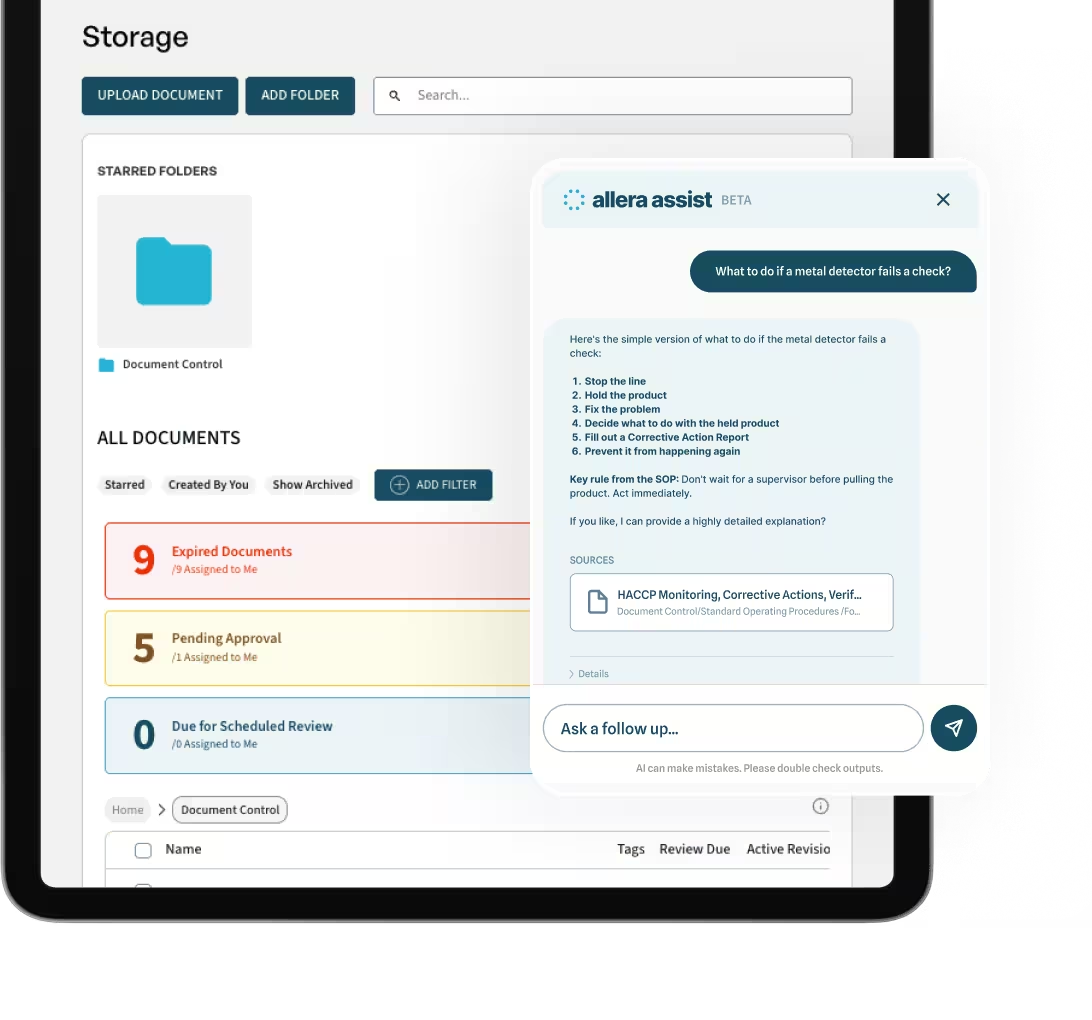
Keeping documentation continuously current is where most of the ongoing effort sits. Allera's Document Control module manages revisions through an approval workflow with Scheduled Review, so documents are flagged before they go overdue rather than after an auditor finds them. The AI Compliance Review feature analyses documents clause by clause against a configured regulatory standard and produces per-clause findings with severity and a suggested corrective action. SQF is the standard configured in the product today, so that capability applies to SQF specifically rather than to BRCGS or FSSC 22000.
What it costs and what drives the cost
Published figures for certification cost are unreliable, and any article quoting a single number for either scheme is guessing. Quotes vary substantially by site size, scope, and certification body.
The drivers are consistent across both schemes:
The scheme fee itself is rarely the deciding factor. A first-time certification costs far more in preparation than in audit fees, and that preparation cost is roughly the same either way if your system needs the same work.
Where cost structures differ, it is usually certification body availability. A scheme with many active CBs in your region gives you competitive quotes and less travel. Check that before assuming the schemes are commercially equivalent in your market. Our top SQF consultants and best FSSC 22000 certification bodies guides cover the provider landscape.
Switching between schemes
Sites switch more often than the marketing suggests, usually because a major customer changed their requirement.
What carries over. Most of your system. Your HACCP plan, prerequisite programmes, supplier approval programme, traceability system, corrective action process, training records, and the great majority of your SOPs remain valid. The food safety substance transfers because both schemes are benchmarked against the same requirements.
What has to be rebuilt. Documentation structure and cross-referencing, since your manual maps to clause numbers that are about to change. Scheme-specific requirements that the other does not have. The named-individual requirement, which may mean training someone as an SQF practitioner. Your internal audit schedule, which needs remapping to the new clause structure.
Realistic timeline. Three to six months for a site with a mature system, longer if the existing system is weaker than the current certificate suggests. The work is mostly documentation remapping rather than operational change, which makes it tedious rather than difficult.
Running both temporarily. Some sites hold both certifications during a transition, usually because customers are split. It is workable and roughly doubles your audit burden, so it is worth a defined end date.
The system underneath is what makes switching easy or hard. A site whose food safety management system is genuinely functioning switches with moderate effort. A site whose system exists mainly to pass audits finds out during the transition.
How to actually decide
Work this sequence in order. The first question that returns a clear answer decides it.
When customers want different schemes
This happens, and there is no elegant answer. Three options in rough order of preference:
Certify to the scheme your largest customer requires and ask the others whether they will accept it, since many will. Certify to the scheme with the broadest acceptance in your sector. Or hold two certifications, which is expensive and occasionally unavoidable.
Do not certify to a scheme nobody asked for on the assumption it will satisfy everyone. Ask first.
Where FSSC 22000 fits
FSSC 22000 deserves consideration as a genuine third option rather than a footnote.
It is built on ISO 22000 plus sector-specific prerequisite programme standards and a set of additional FSSC requirements. That foundation is what makes it attractive to sites already running ISO management systems, since the structure, the management review requirements, and the continual improvement model are already familiar.
It has strong traction with multinational manufacturers and in European supply chains. Our guide to FSSC 22000 vs ISO 22000 covers the relationship, and FSSC 22000 Version 6 covers the current scheme. Note that Foundation FSSC has published Version 7 documents alongside Version 6, so confirm which version applies to your certification timeline before planning against either.
The FSSC 22000 Scheme Version 6 document is available directly from the Foundation.
Ask the customer first
The single most useful thing you can do before committing to a scheme is send one email. Most facilities that choose wrong do so because they assumed a preference that was never stated, and the correction costs a full certification cycle.
Once you know what your customers actually require, the decision usually makes itself. Where it does not, the practical tiebreakers are certification body availability in your region and whether you already run ISO management systems.
Whichever scheme you land on, the ongoing work is the same: keeping documentation current, records complete, and corrective actions closed. To see how that side is managed in one place, take a look at Allera's food quality management software.
FAQs
How long does it take to switch from BRCGS to SQF?
Three to six months for a site with a mature system, and longer where the underlying system is weaker than the existing certificate implies. Most of the work is documentation remapping and training a qualified practitioner rather than operational change, since the food safety substance transfers.
Which GFSI scheme is easiest to get?
None of the recognised schemes is materially easier, because they are benchmarked against a common baseline. What varies is fit. A site with existing ISO management systems finds FSSC 22000 more familiar. A North American site with a US customer base finds SQF better supported. Difficulty depends far more on the current state of your food safety system than on the scheme.
Which is better, SQF or BRCGS?
Neither is better. Both are GFSI-recognised and both are rigorous. If a customer specifies one, that decides it. If none does, choose on your export markets, the certification bodies available in your region, whether a score or a grade suits your organisation, and whether you operate multiple sites.
Can you be "GFSI certified"?
Not literally. GFSI does not issue certificates. When someone says GFSI certified, they mean certified to a GFSI-recognised scheme such as SQF, BRCGS, FSSC 22000, IFS, or PrimusGFS. The shorthand is widely used and generally understood.
Are GFSI and SQF the same thing?
No. GFSI is a benchmarking body that sets requirements certification schemes must meet. SQF is a certification scheme that meets those requirements and is recognised on that basis. You get certified to SQF; you cannot get certified to GFSI.
Is SQF certification better than GMP?
They are different things rather than competing options. Good Manufacturing Practices are the foundational hygiene and operating controls every food facility needs, and they are a regulatory expectation.
SQF is a certification scheme that audits a complete food safety management system, with GMP as one component inside it. You do not choose between them. GMP underpins the system that SQF certifies.
How hard is SQF certification?
Difficulty depends far more on the current state of your food safety system than on the scheme itself. A site with functioning prerequisite programmes, a validated HACCP plan, and disciplined record-keeping is most of the way there.
The common gaps are documentation control, verification records, and internal audit. First certification typically costs more in preparation than in audit fees, and that preparation is similar across any GFSI-recognised scheme.
What is the equivalent of BRCGS?
The closest equivalents are the other GFSI-recognised schemes: SQF, FSSC 22000, IFS, and PrimusGFS. All are benchmarked against the same GFSI requirements and are broadly accepted in place of one another.
Which one suits you depends on your customers, your export markets, whether you already run ISO management systems, and which certification bodies are active in your region.
Is SQF equivalent to BRC?
They are equivalent in the sense that both are benchmarked against the same GFSI requirements and both are accepted as GFSI-recognised certification.
They are not identical in structure, terminology, scoring, or named-individual requirements. SQF uses a points-based score with rating bands, BRCGS issues a letter grade, and a certificate to one does not convert to the other.
What are the three levels of SQF?
SQF is tiered as Fundamentals, Food Safety, and Food Safety plus Quality.
SQF Fundamentals is an entry-level programme designed as a stepping stone and is not GFSI-recognised. If a customer has asked for GFSI-recognised certification, Fundamentals does not satisfy that requirement.
What is equivalent to GFSI?
Nothing is equivalent to GFSI, because GFSI is not a certification. It is a benchmarking organisation, so the question usually means: which schemes does it recognise?
The main GFSI-recognised schemes are SQF, BRCGS, FSSC 22000, IFS, and PrimusGFS. Recognition is granted for defined scopes, so check that a scheme's recognition covers your product category.
Is GFSI the same as FSSC 22000?
No. GFSI is a benchmarking body that sets requirements a certification scheme must meet to be recognised. FSSC 22000 is one of the schemes it recognises.
FSSC 22000 is built on ISO 22000 plus sector-specific prerequisite programme standards and additional FSSC requirements, which makes it a natural fit for sites already running ISO management systems.
Is GFSI certification mandatory?
Not legally. No US regulation requires certification to a GFSI-recognised scheme. FSMA requires a food safety plan, preventive controls, and records, not a certificate.
Commercially it is close to mandatory for anyone supplying major retail or foodservice chains. That is a market requirement rather than a regulatory one.
.avif)
.avif)
.avif)
.avif)
%20(1).avif)
.avif)
.avif)

%20(1).png)

.avif)



.avif)